// fidelity import
Your Fidelity Trading Journal
Journal your Fidelity trades without re-typing them. One Accounts History download covers everything — options, stocks, dividends and transfers — each recognized the moment you drop it in. Even Fidelity's cryptic option symbols become real positions.
One file in · options, stocks & cash · 100% free
// how-to-export
From fidelity.com to your journal
Four steps, about two minutes.
- 01
Open Activity & Orders
On fidelity.com, go to Accounts → Activity & Orders. This is the full record of everything that's moved through the account.
- 02
Pick your date range, download
Choose the period you want and click Download. Fidelity saves one Accounts History CSV — even if it spans more than one linked account.
- 03
Drop the file into the Import Wizard
Settings → Import Data, drag the file in. It's identified as Fidelity automatically — no column mapping, no file cleanup.
- 04
Preview & commit
See every trade before anything is saved. Other-account and core-cash rows are set aside with a count, duplicates are flagged, then trades post to the ledger — opens paired with closes.
// auto-detected
Three asset classes, one file.
Most tools auto-detect one corner of a Fidelity export. TickerScribe reads the whole thing: it decodes "-SPY260720P420" into a real option, pairs the equity buys and sells, records the cash — and quietly leaves out the other account and the core-cash sweeps that don't belong in a trading ledger.
Run Date,Account,Account Number,Action,Symbol,…,Price ($),Quantity,…,Amount ($)columns mapped06/22/2026,"Individual",Z…518,"YOU SOLD OPENING TRANSACTION PUT (SPY) …", -SPY260720P420,…option · sell to open06/24/2026,"Individual",Z…518,"YOU BOUGHT CLOSING TRANSACTION PUT (SPY) …", -SPY260720P420,…option · buy to close06/24/2026,"Individual",Z…518,"YOU BOUGHT NVIDIA CORP (NVDA) (Cash)",NVDA,$124.80,5,…stock · buy06/20/2026,"Individual",Z…518,"DIVIDEND RECEIVED (KO) (Cash)",KO,,,…,$14.20dividend06/15/2026,"Individual",Z…518,"Electronic Funds Transfer Received (Cash)", ,…,"$1,925.00"cash · deposit06/24/2026,"Individual",Z…518,"YOU BOUGHT FIDELITY GOVERNMENT … (SPAXX)",SPAXX,…core sweep · skipped06/14/2026,"Cash Management",X…034,"DEBIT CARD PURCHASE …", ,…,($46.12)other account · skipped"The data and information in this spreadsheet …"footer · skippedStocks·Options·The other account's rows and the legal footer are recognized and skipped — not guessed at.
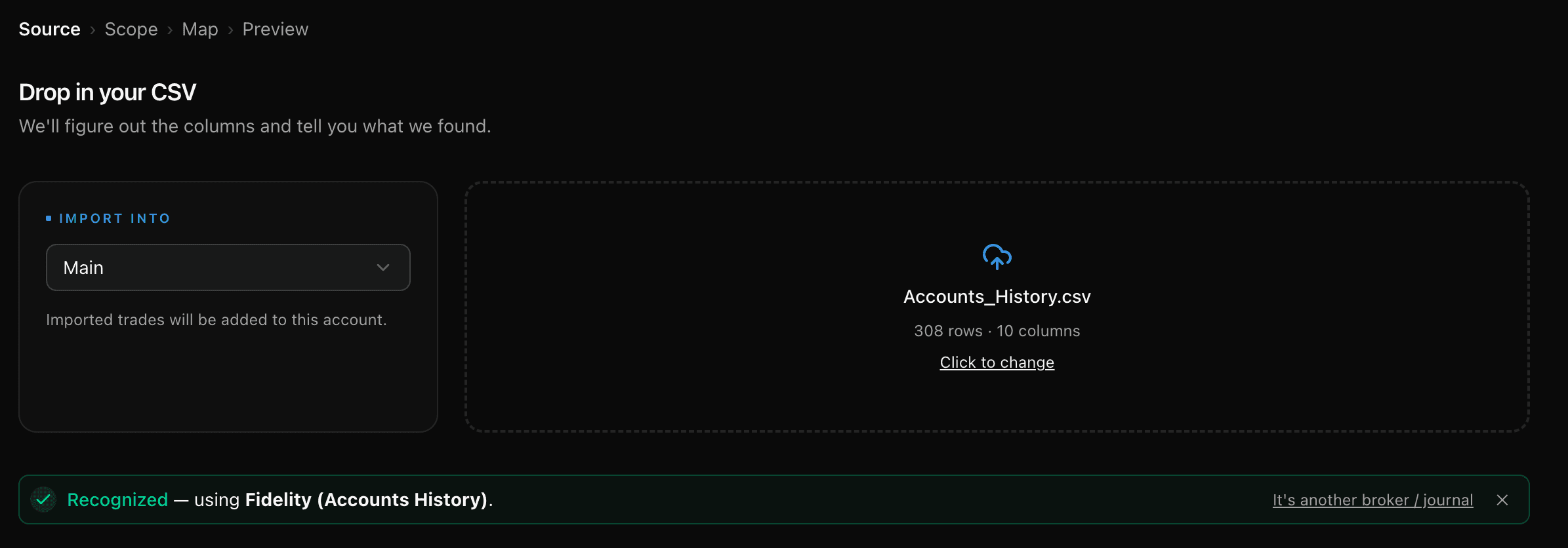
The moment it lands: recognized, every column mapped, ready to preview.
Options
Fidelity's cryptic option symbols like "-SPY260720P420" are decoded into underlying, strike, expiration, and call/put. Opening and closing trades are recognized and paired into round-trips with accurate premiums — and a contract that simply ends, leaving only an "EXPIRED", "ASSIGNED", or "EXERCISED" note in the description, is closed at zero with the reason kept.
Stocks
Buys and sells with their price and quantity — each side identified correctly, not guessed from a sign. Fractional shares come across as the fractions they are.
Dividends, transfers & fees
Dividends keep their ticker; electronic transfers, journals, and fees land as the deposits, withdrawals, and cash events they are — so portfolio value and deployed capital stay accurate.
Only your trading account
An Accounts History export often bundles a linked Cash Management account — debit-card spend, ATM withdrawals, inter-account sweeps. TickerScribe imports the trading account and sets the rest aside, with a count, so internal transfers aren't double-counted.
Core cash, left out
Money-market core moves — SPAXX, FDRXX and the like — look like buys but they're cash parking, not trades. They're skipped and counted, so your real buys and sells stay clean.
Safe re-imports
Every trade carries a content fingerprint. Re-running a file, or importing overlapping date ranges, flags duplicates on the preview step and skips them.
Two minutes from fidelity.com
Your whole Fidelity history, in one place
No credit card required. Export your Accounts History, drop it in — options decoded, cost basis intact.
Frequently Asked Questions
Is TickerScribe really free?
Which Fidelity file does TickerScribe auto-detect?
Do my Fidelity options import automatically?
I have a linked Cash Management account — does that get mixed in?
What about core cash like SPAXX?
Are assignments, exercises, and expirations handled?
Can I import a long history in pieces?
- Interactive BrokersThe Transaction History statement — multi-currency normalized, FX legs filtered.
- thinkorswimThe Account Statement — spread legs reassembled, fees matched, expirations closed.
- SchwabBoth exports work — transaction history and per-holding lot details.
- RobinhoodThe activity report — options parsed from plain text, cash included.
- TradeStationThe trades report — compact option symbols decoded automatically.
- tastytradeThe transaction history — partial fills merged, quoted premiums restored, expirations closed.
- WebullThe order-history export — only filled orders, at their average fill price; unfilled orders set aside.
- AlpacaYour trade activity as a CSV — every fill and partial fill imported at the exact price it executed.
- WealthsimpleThe Activity export — stocks, options, and cash from one file, with per-contract premiums normalized.
- Trade RepublicThe Transaction export — savings-plan fractions, the whole cash ledger, splits netted and name changes followed.
- E*TRADEThe Transaction History CSV — options, stocks and cash, with the contract read from the description rather than the underlying.
- M1The Activity export — fractional notional orders priced from the cash they actually moved.
- Every other broker & journal — the universal CSV mapper
// keep exploring
Explore More Features
Options Journal
30+ strategies, rollover chains, Greeks & IV, per-leg P&L.
Stock Journal
Position grouping, cost basis methods, and one-click logging.
Short Selling
A sell that opens the position, a buy-to-cover that closes it, P&L the right way round.
Daily Journal
State, plan & checklist, mood & reflection, tags and screenshots — per day.
Trade Log
Every trade on one row — notes and tags in place, reviewed beside the chart.
Performance Dashboard
KPIs, cumulative P&L chart, and portfolio overview.
P&L Calendar
Shareable daily P&L heatmap with drill-down.
Trade Analysis
Price ranges, day-of-week P&L, and time-of-day patterns.
Wheel Analysis
Puts, covered calls, and assignments — stitched into cycles with annualized return.